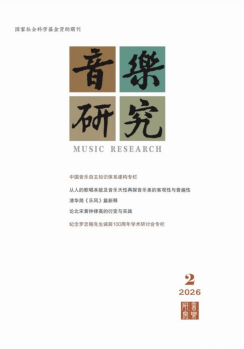
Recently, Dr. Zhang Xiaowei from our School published a sole-authored article titled “A Textual Research on the Year of Mao Minzhong’s Death and His ‘Loyalist Compositions’”(毛敏仲卒年与“遗民曲”创作考论) in the 2026 Issue No. 2 of Music Research.
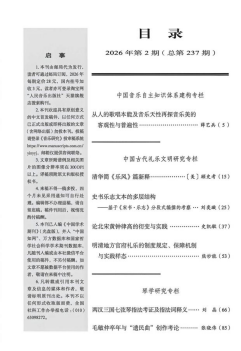
Adhering to the scholarly tradition of tracing origins and examining academic lineage, the paper conclusively demonstrates that Mao Minzhong’s journey to Dadu, the capital of the Yuan Dynasty, occurred around the 26th year of the Zhiyuan reign (1289 CE). It confirms that Mao had over a decade to compose his “loyalist compositions” (music reflecting the sentiments of a fallen dynasty). Specifically, the piece Yu Meets at Mount Tu(《禹会涂山》) was composed prior to 1285 and originally featured a dual thematic structure before being renamed Sightseeing in the Imperial Capital(《上国观光》) in 1289. Furthermore, the article provides exhaustive textual research on related historical details, including the death year of the qin master Xu Tianmin, the timeline of Wang Yuanliang’s meeting with Mao Minzhong in Hangzhou, and the number of poems Wang dedicated to Mao and their textual variants. The study argues that the significant shift in Mao Minzhong’s compositional style before and after the fall of the Song Dynasty was pivotal in cementing both his own legacy and that of the Zhejiang School of Guqin within music history.
Founded in 1958, Music Researchis one of China’s earliest national-level academic journals dedicated to music. It is a recipient of funding from the National Social Science Fund and is designated as a Tier-1 authoritative journal in the field of music by multiple research institutions. It is reported that Dr. Zhang Xiaowei dedicated nearly a decade to this research project. This publication represents not only the culmination of years of rigorous individual scholarship but also a significant achievement for our School in the discipline of music studies.
.png)